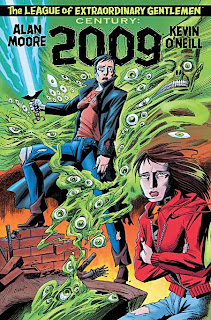
League Of Extraordinary Gentlemen: Century 2009. Alan Moore and Kevin O’Neill. Top Shelf. 80 pages. $9.99.
If
all you know of LOEG is that dreadful film, you’re missing one of the
richest and most-entertaining series in comics, which also serves as a
powerful commentary on decadence, the necessity of a diverse culture and
its relevance to life. This final chapter in the third volume of
stories continues Moore’s heady blend of occult, politics and adventure,
culminating with the coming of the antichrist and the subsequent
arrival of … well, that would be telling.
As usual, there’s an all-star
assemblage of borrowed characters, though few are specifically named.
The identity of the antichrist drew a bit of contrived controversy when
this book first appeared in the UK, but the presence of this corrupted
persona is well within the traditions of literary satire. Century 2009
is a mostly satisfying conclusion to this volume, nicely setting up
Moore’s next tale — a visit with Captain Nemo set in an earlier time,
due in 2013.
Get Jiro. Anthony Bourdain, Joel Rose and Langdon Foss. Vertigo. 160 pages. $24.99.
Chef,
author and TV personality Bourdain’s manic parable posits an epicurean
dystopia with bloodthirsty chefs and food to die for. The violent fable
deftly skewers feckless foodie pretensions, especially in California,
and Foss’ well-done art imparts a delicious and tasty sizzle.
Batman: Earth One. Geoff Johns and Gary Frank. DC Comics. 128 pages. $22.99.
Though
no one yearned for yet another retelling of the beginnings of Batman,
Johns and Frank deliver a startlingly fresh take that incorporates many
elements of the first origin of the Dark Knight while adding some smart
and engaging emotional beats. Frank is one of DC Chief Creative Officer
Johns’ go-to guys, and he once again rises to the occasion with powerful
and effective pencils, ably delineated by Jon Sibal.
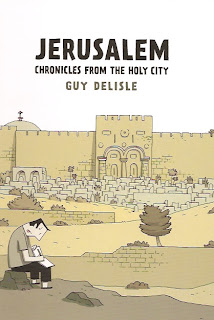
Jerusalem: Chronicles From The Holy City. Guy DeLisle. Drawn & Quarterly. 320 pages. $24.95.
Another
eloquent and sensitive cartoonist attempts to explicate the conundrum
that is Jerusalem, the Holy City of three religions. If you’re
unfamiliar with the complicated and conflicted landscape, DeLisle brings
the divergence down to ground level. The Canadian’s art is simple and
effective, and he doesn’t preach or proselytize as much as gamely
attempt to explore and find meaning in the mundane and ordinary aspects
of life in this far-from-ordinary setting.
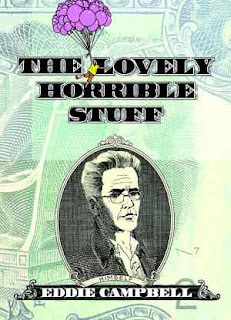
The Lovely Horrible Stuff. Eddie Campbell. Top Shelf. 96 pages. $14.95.
The From Hell
artist and Alec auteur’s painfully honest and often hilarious look at
money, relationships, life and art delves deep into his family history
and world explorations. Campbell is quite a character, and his
experiences and insights on how we deal with high and low finance make
for a funny, rewarding and frankly educational experience.
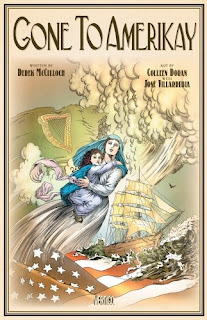
Gone To Amerikay. Derek McCulloch and Colleen Doran. Vertigo. 144 pages. $24.99.
Master
storyteller McCulloch’s wise and poignant tale of Irish immigrants
coming to America, weaving three different time periods in parallel, is
soulfully illustrated by veteran artist Doran. It’s a heartfelt and
genuine story of human emotions and drama; nothing post-modern, snarky
or ironic here, just believable behavior depicted with lyrical dialog
and rich imagery. You’ll want to re-read it as soon as you finish to
savor and reflect upon the transcendent intelligence and artistic vision
responsible for this masterpiece. Highly recommended.
Fairy Tales of Oscar Wilde: The Happy Prince. P. Craig Russell. NBM. 32 pages. $16.99.
Wilde’s
beloved allegory is beautifully and smartly adapted by master craftsman
Russell. The story, timeless and relevant, centers on a statue of a
chastened prince who aches for his poor subjects and aids some of them
with the help of a friendly, anthropomorphic swallow. The tale of the
lifeless boy and the faithful avian is conveyed sweetly and with great
heart. Special mention to Lovern and Jesse Kindzierski for their
intelligent and sympathetic coloring.
Harvey Pekar’s Cleveland. Harvey Pekar and Joseph Remnant. Top Shelf. 128 pages. $21.99.
In this, one of the American Splendor creator’s
final projects, the reader experiences an intimate portrait of the late
Pekar’s life and work. Considering the autobiographical focus of almost
all of his stories, it’s pretty amazing, but the casual revelations
about himself and his beloved city are bracing and revelatory. More than
a coda, it’s a wonderful conclusion to one of the medium’s great bodies
of work. Remnant’s art is fresh and familiar, and one of the best of a
long series of collaborations between Pekar and other expert and
simpatico illustrators. Harvey lives!
Showing posts with label Eddie Campbell. Show all posts
Saturday, August 18, 2012
Sunday, February 14, 2010
Round Up: From anthologies to Detectives to Johnny Cash
BY RICHARD PACHTER

The Best American Comics 2009. Charles Burns, Jessica Abel & Matt Madden, editors. Houghton Mifflin Harcourt. 332 pages.
Like a greatest hits collection from indy labels, this "best of'' eschews contributions from the majors, so there are no mesomorphic crimefighters, though there are several anthropomorphic animals and plenty of angst-y adolescents. Editors Abel and Madden, joined by the eminently estimable Burns, assemble stellar contributions from all-stars Clowes, the Crumbs, Kupperman, Pond, Spiegelman, Tomine, Ware and others. There's something to appeal to most every taste, though you'll have to decide for yourself if it all adds up to "the best.''

Johnny Cash: I See A Darkness. Reinhard Kleist. Abrams ComicArts. 224 pages.
Originally published in Germany and written in that country's language, this graphic bio of the country legend is told affectionately, despite unfolding like a restless nightmare in stark black and white. Though it may not strictly stick to the facts, this visceral tale of Johnny Cash's rise and fall and rise again is lyrical and haunting.


Luna Park. Kevin Baker. Danijel Zezelj. Vertigo. 160 pages.
Baker's hallucinogenic dream of Russian survival in Coney Island, Afghanistan and Dallas blends history, pulp fiction and fantasy, with Zezejl's perfect art, and a didn't-see-it-coming, jaw-dropping final twist.


Detectives Inc. Don McGregor. Marshall Rogers. Gene Colan. IDW. 160 pages
.
Don McGregor's pair of groundbreaking graphic novels, with art by the late Marshall Rogers and the great Gene Colan, is back in print in this lovingly produced collection, replete with script samples, reminiscences and more, plus stills and text from a film adaptation. McGregor's scripts may seem wordy and violet-hued to some, but his honesty, sincerity and humanity always shine through. Bits of ancillary material were obviously reproduced from secondary sources, but the stories themselves are crisp and sharp and hold up quite well, all things considered.


Alec: The Years Have Pants (A Life-Sized Omnibus). Eddie Campbell. Top Shelf.
If autobiography is the lingua franca of the graphic novel form, Campbell is its undisputed Shakespeare. The consistency and growth of the artist's narrative skills and draftsmanship are unique though unsurprising. This long-awaited collection that gathers 30 years of disparately published stories limning the life and loves of Campbell's alter ago, Alec, will undoubtedly top every year's-best list, including mine.

Talking Lines. R. O. Blechman. Drawn and Quarterly. 288 pages. $27.95.
Blechman's beautiful squiggly drawings are instantly recognizable to generations of magazine readers. This lovely and overdue collection makes an eloquent case for the prodigious talents and seriously whimsical art of a modern master. The accompanying text is similarly enlightening and almost as entertaining.


Dread & Superficiality: Woody Allen as Comic Strip. Stuart Hample. Abrams ComicArts. 240 pages.
Inside Woody Allen was a fun and funny strip when it ran in newspapers (from 1976 to 1984), though none ran front-page retrospectives mourning its demise. But this thorough collection is an unexpected delight. As a primer for would-be cartoonists, the text provides great insights into the development of this sadly dying art form. Creator Hample collaborated loosely with subject Allen, abetted by several writers, including, astonishingly, The Cluetrain Manifesto's David Weinberger, now a Harvard professor, but then a Ph.D. philosophy candidate, which pleased the Woodman to no end, no doubt.
The Best American Comics 2009. Charles Burns, Jessica Abel & Matt Madden, editors. Houghton Mifflin Harcourt. 332 pages.
Like a greatest hits collection from indy labels, this "best of'' eschews contributions from the majors, so there are no mesomorphic crimefighters, though there are several anthropomorphic animals and plenty of angst-y adolescents. Editors Abel and Madden, joined by the eminently estimable Burns, assemble stellar contributions from all-stars Clowes, the Crumbs, Kupperman, Pond, Spiegelman, Tomine, Ware and others. There's something to appeal to most every taste, though you'll have to decide for yourself if it all adds up to "the best.''
Johnny Cash: I See A Darkness. Reinhard Kleist. Abrams ComicArts. 224 pages.
Originally published in Germany and written in that country's language, this graphic bio of the country legend is told affectionately, despite unfolding like a restless nightmare in stark black and white. Though it may not strictly stick to the facts, this visceral tale of Johnny Cash's rise and fall and rise again is lyrical and haunting.
Luna Park. Kevin Baker. Danijel Zezelj. Vertigo. 160 pages.
Baker's hallucinogenic dream of Russian survival in Coney Island, Afghanistan and Dallas blends history, pulp fiction and fantasy, with Zezejl's perfect art, and a didn't-see-it-coming, jaw-dropping final twist.
Detectives Inc. Don McGregor. Marshall Rogers. Gene Colan. IDW. 160 pages
Don McGregor's pair of groundbreaking graphic novels, with art by the late Marshall Rogers and the great Gene Colan, is back in print in this lovingly produced collection, replete with script samples, reminiscences and more, plus stills and text from a film adaptation. McGregor's scripts may seem wordy and violet-hued to some, but his honesty, sincerity and humanity always shine through. Bits of ancillary material were obviously reproduced from secondary sources, but the stories themselves are crisp and sharp and hold up quite well, all things considered.
Alec: The Years Have Pants (A Life-Sized Omnibus). Eddie Campbell. Top Shelf.
If autobiography is the lingua franca of the graphic novel form, Campbell is its undisputed Shakespeare. The consistency and growth of the artist's narrative skills and draftsmanship are unique though unsurprising. This long-awaited collection that gathers 30 years of disparately published stories limning the life and loves of Campbell's alter ago, Alec, will undoubtedly top every year's-best list, including mine.
Talking Lines. R. O. Blechman. Drawn and Quarterly. 288 pages. $27.95.
Blechman's beautiful squiggly drawings are instantly recognizable to generations of magazine readers. This lovely and overdue collection makes an eloquent case for the prodigious talents and seriously whimsical art of a modern master. The accompanying text is similarly enlightening and almost as entertaining.
Dread & Superficiality: Woody Allen as Comic Strip. Stuart Hample. Abrams ComicArts. 240 pages.
Inside Woody Allen was a fun and funny strip when it ran in newspapers (from 1976 to 1984), though none ran front-page retrospectives mourning its demise. But this thorough collection is an unexpected delight. As a primer for would-be cartoonists, the text provides great insights into the development of this sadly dying art form. Creator Hample collaborated loosely with subject Allen, abetted by several writers, including, astonishingly, The Cluetrain Manifesto's David Weinberger, now a Harvard professor, but then a Ph.D. philosophy candidate, which pleased the Woodman to no end, no doubt.
originally published in The Miami Herald
Thursday, January 14, 2010
Zombies, Dylan and the Bible
BY RICHARD PACHTER
The Zombie Survival Guide: Recorded Attacks. Max Brooks and Ibraim Roberson. Three Rivers.
Brooks' silly and self-important "historical'' zombie vignettes serve as illustrated back-stories to his popular series of expository zombie prose novels. It's a decent enough gimmick, and this graphic treatment might be entertaining and important to acolytes and fans of his other undead work. But the only redeeming feature for the unconvinced is the lithe and imaginative illustrations and vivid storytelling of Ibraim Roberson, whose craft and skill far outclasses Brooks' moribund material.
This French collection of illuminated Dylan lyrics, illustrated by an international, non-American team of artists is a mixed bag. Some of the selections seem odd choices for graphic retelling; others represent missed opportunities. But when things click, like in Dave McKean's Desolation Row, Gradimir Smudja's Hurricane and Zep's Not Dark Yet, you can see the promise of the concept. But most of the interpretations are a bit too serious and austere to justify the effort.
Reunions are usually iffy, which is why Eisner wisely resisted revisiting his creation, The Spirit, except for a few brief encounters. But he finally acquiesced to publisher Denis Kitchen's entreaties to allow other creators to play with his most famous character. The result was an eight-issue series that's gorgeously reproduced in this volume. Artists and writers alike were canny enough to resist slavish mimicry, bringing a new energy to the strip while retaining the original noir-ish blend of innovation and tradition. Alan Moore, Dave Gibbons, Eddie Campbell, Kurt Busiek, Tom Mandrake, John Ostrander, Paul Chadwick and others clearly had a ball with their stellar homages to The Spirit of Will Eisner.
The good news is that Crumb tackles the Bible -- but that's the bad news too. While his draftsmanship and composition have never been better, the material is, frankly, weak, hackneyed and disjointed. Unless readers allow their own transcendent faith and suspension of disbelief to make it more than what it is, Crumb's visual tour de force is for naught.
Sikoryak's astonishing mashups take classics from Shakespeare, Camus, Bronte and the Bible and combines them with the hoary comics motifs of Batman, Superman, Mary Worth, Blondie, EC, Garfield and more. He's a terrific artist, and his awesome mimicry and maniacal imagination will startle and delight litt'rateurs and fanboys alike.
Logicomix: An Epic Search for Truth. Apostolos Doxiadis, Christos H. Papadimitriou, Alecos Papadatos, Annie Di Donna. Bloomsbury.
This amazing and rewarding book presents a portrait of Bertrand Russell -- of all people -- and his quest for meaning in logic and romance. The book's creative team also appears as characters in their resonant and interesting evocation, using of the graphic format in an imaginative and engaging way.
Originally published in The Miami Herald
Sunday, October 26, 2008
The Alcoholic and Monsieur Leotard
A couple of capsule reviews from The Miami Herald. It's not easy writing short!

The Alcoholic. Jonathan Ames and Dean Haspiel. Vertigo. 136 pages.
Jonathan Ames is a successful performer, essayist and novelist of mostly noirish detective fiction. Aided by artist and American Splendor stalwart Dean Haspiel, he recounts his life of sexual ambiguity, substance abuse, and affairs of the heart and other organs. An unrequited boyhood crush and the unconditional love of a favorite aunt provide resonant and visceral emotional counterpoints. Haspiel's images are powerful and complementary. As with the best art, the reader is left wondering what's next.

The Amazing Remarkable Monsieur Leotard. Eddie Campbell and Dan Best. First Second. 128 pages.
English expatriate and resident Aussie artist and writer Eddie Campbell's autobiographical Alec stories are finally collected later this year, but From Hell, the revisionist Jack The Ripper series with Alan Moore, is his claim to mainstream fame. This gorgeous new work, an entertaining collaboration with Brisbane attorney and writer Dan Best, is a colorfully frothy fantasy extrapolating a biography for the imaginary nephew of famed acrobat Jules Leotard, the original ''daring young man on the flying trapeze'' for whom leotards are named. His misadventures with an endearing supporting cast form a hilarious and astounding epic that culminates in the creation of (what else?) the first comic book superhero.

The Alcoholic. Jonathan Ames and Dean Haspiel. Vertigo. 136 pages.
Jonathan Ames is a successful performer, essayist and novelist of mostly noirish detective fiction. Aided by artist and American Splendor stalwart Dean Haspiel, he recounts his life of sexual ambiguity, substance abuse, and affairs of the heart and other organs. An unrequited boyhood crush and the unconditional love of a favorite aunt provide resonant and visceral emotional counterpoints. Haspiel's images are powerful and complementary. As with the best art, the reader is left wondering what's next.

The Amazing Remarkable Monsieur Leotard. Eddie Campbell and Dan Best. First Second. 128 pages.
English expatriate and resident Aussie artist and writer Eddie Campbell's autobiographical Alec stories are finally collected later this year, but From Hell, the revisionist Jack The Ripper series with Alan Moore, is his claim to mainstream fame. This gorgeous new work, an entertaining collaboration with Brisbane attorney and writer Dan Best, is a colorfully frothy fantasy extrapolating a biography for the imaginary nephew of famed acrobat Jules Leotard, the original ''daring young man on the flying trapeze'' for whom leotards are named. His misadventures with an endearing supporting cast form a hilarious and astounding epic that culminates in the creation of (what else?) the first comic book superhero.
Subscribe to:
Posts (Atom)


